
Sculptural Home Decor: When Objects Become Art
The design shift that is redefining what belongs in a beautiful home

Sculptural home decor is 2026’s defining interior concept. Here is why it matters.
Something has shifted in how people think about the objects in their homes. The question is no longer only ‘is this useful?’ or even ‘is this beautiful?’ The question becoming central to the most considered interiors is ‘does this object have presence?’ — the quality of occupying space with authority, of being worth looking at from every angle, of suggesting that it was made by someone with a genuine point of view about form.
This is sculptural home decor. Not sculpture in the museum sense — art placed on a plinth and contemplated from a distance. Sculpture as a quality applied to objects that live with you: a candle vessel on a coffee table, a vase on a console, a stone object on a bathroom shelf. These objects perform the same visual function as sculpture — they create points of focus, they reward looking, they shape the atmosphere of the room they inhabit — while remaining fully at home within everyday life.
What Makes a Decorative Object Sculptural?
Form that exists independently of function
A sculptural object has a form that is interesting before you know what it does. A marble fragrance diffuser vessel designed with architectural reference and precise surface finishing is interesting as a stone object before you have registered that it holds fragrance. This independence of form from function is the primary quality that makes an object sculptural rather than merely functional.
Three-dimensional interest
Sculptural objects reward being looked at from multiple angles. They are not flat compositions — they have depth, shadow, surface variation, and proportional relationships that change as you move around them. Natural stone materials are particularly well-suited to this: marble and sandstone have tonal variation, surface texture, and light-catching qualities that make them visually different at every angle and under every lighting condition.
Material integrity
The materials of a sculptural object communicate its quality before any other information reaches conscious awareness. Natural stone — particularly marble and sandstone — has an immediate visual and tactile authority that synthetic materials cannot replicate. Weight, temperature, and surface variation all contribute to the impression of an object made from a material that is genuinely what it appears to be. Material integrity is the foundation of sculptural presence.
The 2026 Turn Toward Sculptural Objects
Multiple major design sources have identified 2026 as the year sculptural objects move from designer secret to mainstream expectation. The shift is driven by several converging forces: the return of ornamentation in architecture (cited by Homes & Gardens, December 2025); the growing influence of Design Miami and Maison & Objet’s collectible design segment; the slow decorating trend, which prioritises fewer, better objects over constant refreshing; and a wholesale rejection of the flat, print-based decorating aesthetic that dominated the early Instagram era.
What is replacing it is three-dimensional, material-rich, and genuinely considered. The shelf that once held printed quotes in serif frames now holds a single stone object and a ceramic piece and a book with a beautiful spine. The coffee table that once had a tray of the same five items now has one object worth looking at from the sofa for thirty minutes. This is the sculptural interior movement — and it is only beginning.
How to Introduce Sculptural Decor Into Any Room?
The one-object rule
You do not need to replace your entire home with sculptural objects. Begin with one surface — your coffee table, your entrance console, your bathroom shelf — and place one genuinely sculptural object there. Remove everything else from that surface. Live with just the one object for a week. The effect will be more dramatic than you expect: a single well-chosen object on a clear surface has more presence than ten objects competing for attention.
Choose objects with surface variation
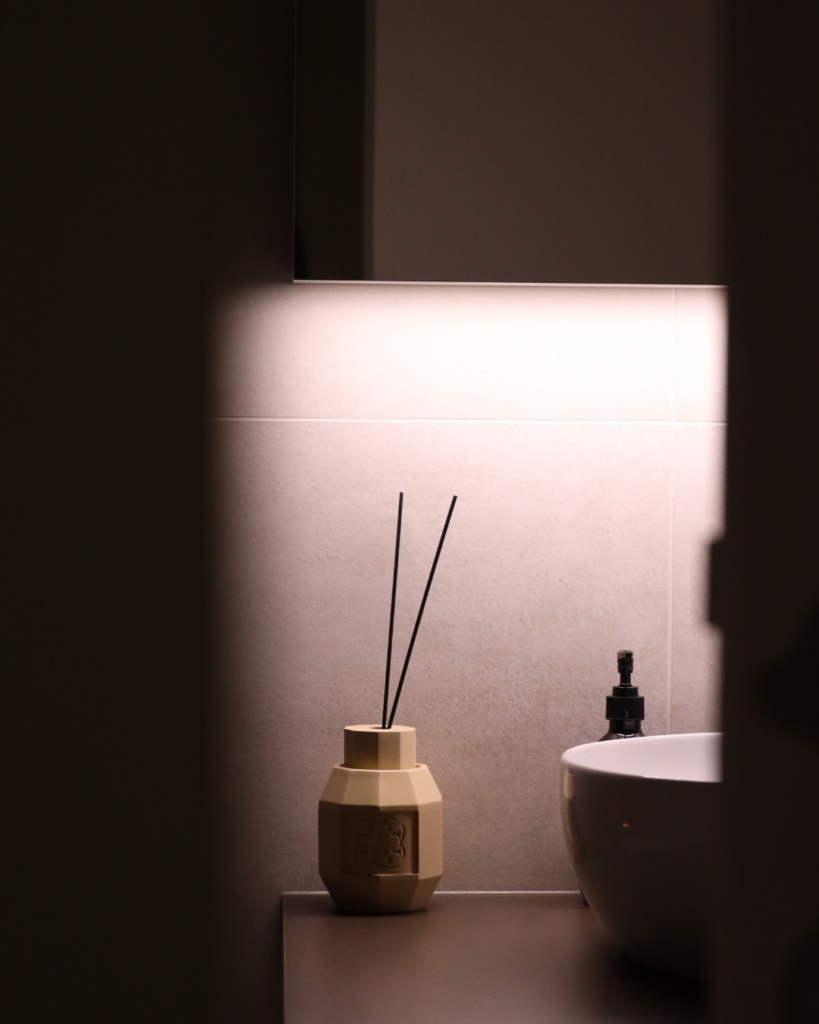
The fastest way to introduce sculptural quality is through materials with natural surface variation: marble, travertine, sandstone, ceramic with an organic glaze, untreated wood with visible grain. These materials produce visual interest at rest — their surfaces do not require additional objects or arrangements to be compelling. A Flamme d’Élixir stone vessel sitting alone on a shelf is a visual event. A glass jar in the same position is not.
Proportion matters more than size
Sculptural impact is not about scale. A small object with excellent proportions has more visual authority than a large object with mediocre form. Consider the relationship between the object and the surface it sits on — ideally the object should occupy roughly 20–30% of the surface area, leaving space to breathe. The negative space around a sculptural object is part of its composition.
Sculptural Objects and Flamme d’Élixir
Every Flamme d’Élixir scented object is designed as a sculptural object first. The marble and sandstone forms are developed in response to the architectural stone language of France — the proportions, surface treatments, and material choices reference the buildings of a city built almost entirely from hand-cut limestone and sandstone. The result is objects that are immediately recognisable as designed, visually interesting from every angle, and material-honest in the most direct sense.
The fragrance contained within each vessel is not the object’s design justification — it is an extra dimension of pleasure layered onto an object that would be worth keeping regardless. This is the sculptural object philosophy applied to the luxury home fragrance category: design first, always.
Frequently Asked Questions
What is sculptural home decor?
Sculptural home decor refers to decorative objects designed to function as three-dimensional art within a home. Objects with form interesting enough to reward looking at from any angle, made from materials with natural visual variation and integrity. Sculptural decor bridges art and function. It is beautiful enough to stand as art but designed to live within everyday spaces.
What materials work best for sculptural home decor?
Natural stone, ceramic with organic glazing, untreated wood, cast metal, and aged brass are the most effective sculptural decor materials. All share the quality of natural surface variation. Their surfaces are visually interesting at rest, without requiring additional styling or arrangement to be compelling.
How do I style sculptural objects in a modern home?
Use the one-object rule: place a single sculptural object on a clear surface and remove everything else. This gives the object room to be seen. Proportion matters — aim for the object to occupy 20–30% of the surface area. Choose materials with surface variation (marble, stone, ceramic) that catch and change with natural light. Resist the impulse to group too many objects together — negative space around a sculptural piece is part of its visual composition.
Is sculptural decor only for minimalist homes?
No — sculptural objects work in all interior styles. In minimalist spaces, a single sculptural object creates the room’s focal point. In layered, maximalist rooms, sculptural objects with strong form and material presence hold their own visually against richer surroundings. The key is choosing objects with genuine three-dimensional interest rather than flat, print-based decoratives.
Leave a Reply